13 November 2026 Reading time: 4 minutes

Roba creates space and energy

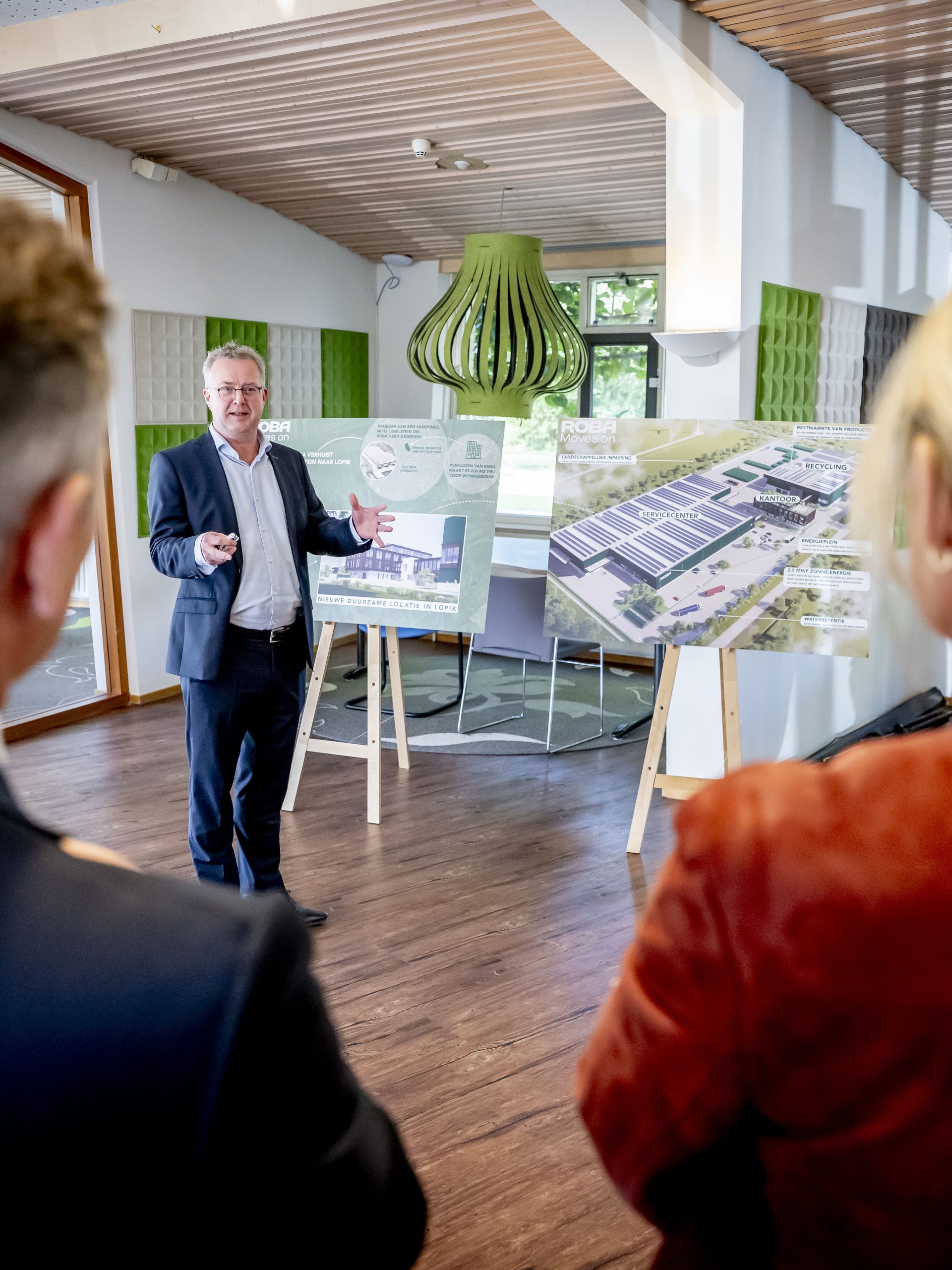
On Monday, September 21, 2026, we welcomed the Minister of Housing and Spacial Planning and the State Secretary for Climate and Green Growth to Roba IJsselstein. The visit centered on the future ‘IJsseloevers’ residential development, which is set to be built on the Roba site. We demonstrated to them that when various parties collaborate and think creatively, new constructino is indeed possible – even in the face of grid congestion.

Achieving this required Roba, grid operator Stedin, the Province of Utrecht, project developer Heijmans, and the Municipality of IJsselstein to truly stick their necks out. By choosing to think differently together, we are making the seemingly impossible possible.

Overloaded power grid

In 2022, when we purchased the land in Lopik, the power grid was not yet severely congested. We therefore simply assumed that we would be able to secure a grid connection. As it turned out, that was not the case, leaving us with no choice but to pursue a fully off-grid installation. Challenging? Certainly. But not impossible. Then, this year, an opportunity suddenly appeared.

Following numerous discussions, possibilities emerged for us to act as a “grid congestion mitigator.” This allowed us to leverage the investments we had already planned for an off-grid future to help alleviate congestion for the grid operator, Stedin. It is a win-win situation for all parties involved: we help relieve the strain on the power grid, while the payback period for our investments is reduced.

What have we invested in?

2.5 MWp of solar panels, a battery with a 4 MWh capacity and 1 MW power output, an 8,000-liter thermal battery used as a heat buffer for heating the premises, a 1.1 MW generator, an Energy Management System, and a building management system.

Grid congestion occurs when, at certain times, too much power is drawn from or fed back into the grid, and the existing electrical cables are unable to transport it to the required locations. This results in an imbalance. At its new location, Roba is able to adjust its power load whenever the grid is under strain.

How do we help?

Our battery can supply or absorb approximately 1 MW of power continuously for four hours. If we require 2 MW but the grid can only provide 1 MW, our battery supplies the remaining 1 MW. Consequently, when Stedin detects that the grid is becoming overloaded, our Energy Management System can ensure that we temporarily reduce our electricity consumption and feed some of our available energy back into the grid to help stabilize it. This Energy Management System can identify major energy-consuming equipment—such as charging stations and heat pumps—and temporarily scale back their usage. This provides flexibility without requiring an immediate halt to production.

Then there is the thermal battery, which uses 8,000 liters of oil—a particularly interesting feature. Normally, one might use electrical energy to generate heat during peak demand periods. With this thermal battery—which is charged using heat recovered from our production equipment—we can store heat and release it whenever our facilities require it. This eliminates the need to draw additional electricity for heating at those times.

The solar panels, combined with an Energy Management System, allow us to direct surplus power to a battery, shift production processes to hours with high solar yield, and limit the amount of energy fed back into the grid when requested. A generator is available to provide additional flexibility if needed. Should Stedin issue a load-shedding request—or in the event of a power shortage—a portion of our production operations can run entirely on self-generated energy. Our building management system ensures that all facility-related installations respond automatically; for example, by dimming lights, managing electric vehicle charging stations, or adjusting temperature and ventilation settings.

Collectively, these components create a flexible energy system. This enables us—at Stedin’s request—to temporarily reduce our power consumption from the grid or, conversely, to feed energy back into it. In effect, we function as a small, controllable power plant that helps to buffer peaks on the grid.

 

Textbook example

A few years ago, the relocation to Lopik appeared to be primarily a logistical and business-related move. Since then, the project has evolved into an example of how collaboration, perseverance, and creativity can contribute to solutions for one of the greatest challenges of our time. The fact that this initiative enables the construction of 563 homes, while simultaneously allowing Roba to contribute to a more stable electricity grid, makes this development all the more remarkable.